Can you predict the winning numbers? The people who really beat chance
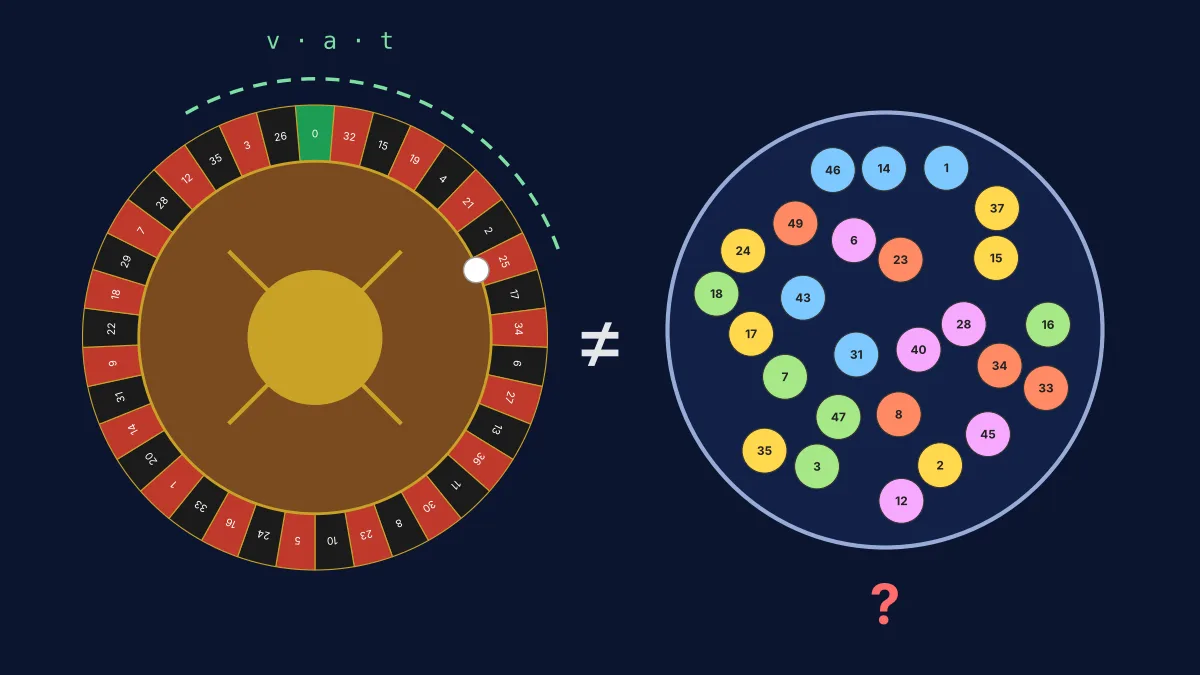
"The draw machine is mechanical, it is subject to physical constraints, so perfect randomness is impossible." You often hear this idea, along with the hope of rebuilding the machine on a computer to get closer to the winning numbers. It is not absurd: a few people really have beaten games of chance. Here is how they did it, and a test of the most popular prediction methods on 20 years of EuroMillions.
Four times chance was really beaten
1. A biased roulette wheel. The best-known story is that of Joseph Jagger, an English engineer who reportedly had the roulette results in Monte Carlo recorded in 1873 and won on an unbalanced wheel. The details, however, are poorly documented. The case of the Spaniard Gonzalo García-Pelayo is much better recorded: in the early 1990s he and his family logged tens of thousands of spins at the Casino Gran Madrid and used a computer to find numbers that came up more often than chance allows. The casino banned him and sued. The Spanish courts ruled: no cheating, just ingenuity and computing.
2. Physics in real time. In 1961 the mathematician Edward Thorp and the father of information theory, Claude Shannon, built a small computer hidden under their clothes, operated by switches in a shoe. It measured the speed of the ball and the wheel and predicted the section where the ball would land. In tests in Las Vegas, Thorp reported a 44% edge on a single number. In 2012 the physicists Michael Small and Chi Kong Tse showed with a simple model an expected return of at least 18%, instead of the usual −2.7%.
3. A flaw in the game itself. The Canadian statistician Mohan Srivastava noticed that on a tic-tac-toe scratch card sold in Ontario, the visible numbers gave away what was hidden under the coating. He could spot winning tickets with about 90% accuracy. Instead of cashing in, he told the lottery, which pulled the game the next day.
4. Cheating. On 24 April 1980, Pennsylvania's Daily Number came up 666. The draw's host, Nick Perry, and his accomplices had weighted every ball except the 4s and 6s. The payout: $3.5 million. Unusual bets on exactly those combinations and an anonymous tip put investigators on the trail, and Perry was sentenced to seven years. A modern case is Eddie Tipton, who programmed the random number generator himself.
What these cases share: a measurable physical defect, information obtained before the final result, a design flaw, or fraud. Not one of them predicted the numbers from past draws.
Why the lottery is different
No bets after the start. At roulette you can still bet while the ball is spinning. That is exactly what Thorp exploited. In a lottery, sales close before the draw; according to FDJ, the EuroMillions draw only starts once the close of sales has been confirmed. Watching the balls in the machine is no use any more.
Tested balls, rotating sets. At France's FDJ, each LOTO ball is 5 cm wide and weighs 26 grams. An external body checks mass, size and bounce twice a year, and the balls are even X-rayed. There are several official ball sets, which rotate on a schedule over several months. For EuroMillions, a court officer breaks the seal on the ball case and signs the official record.
Too little data for a bias. García-Pelayo needed tens of thousands of spins on a single wheel. A lottery draws two or three times a week, with changing ball sets. A small bias would be rotated away long before it could be measured. We checked this in detail in our article Another machine, other numbers?
The test: 20 years of EuroMillions against prediction methods
We tested six methods on 1,889 EuroMillions draws (January 2006 to October 2026). For each draw, each method picks 5 main numbers using only the draws before it, just like a real player:
- Hot numbers: the 5 most frequent numbers of the last 50 draws.
- Overdue numbers: the 5 numbers missing for the longest time.
- Numbers from the last draw: simply play them again.
- Most frequent since 2004: the 5 all-time leaders.
- "Virtual machine": before each draw we simulate 2,000 draws on a machine whose balls come out exactly as often as observed so far, and play the 5 numbers that came up most in the simulation.
- Random pick: 5 numbers chosen by lot, for comparison.
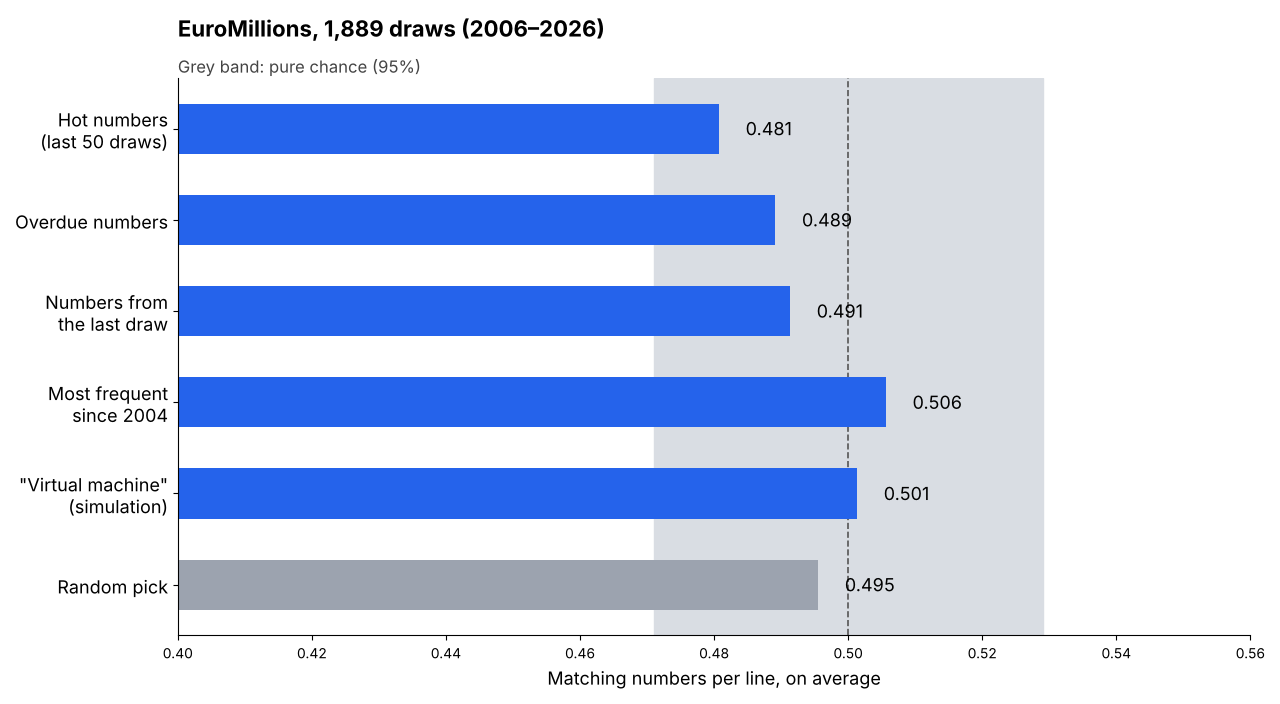
The result is clear: no method beats a random pick. The values range from 0.481 to 0.506 matching numbers per line, against 0.500 expected. The share of lines with at least 2 matches is between 6.5% and 7.9% everywhere, against 7.2% in theory. The "virtual machine" lands on 0.501, almost exactly on the expected value.
Why the simulation still feels "so close"
A simulation only knows its own assumptions. A virtual machine does not copy the real machine, only what you assumed about it. If the real machine is fair, the virtual one predicts nothing.
Many lines, many near misses. Check 1,000 lines per draw in a simulation and, on average, every draw gives you 4 or 5 lines with 3 matching main numbers, and about every 9 to 10 draws one line with 4. It feels like being very close, but it is exactly what chance delivers.
The brain loves near misses. Researchers at the University of Cambridge (Clark et al., Neuron, 2009) showed that a near miss activates the same reward areas of the brain as a win. Participants found near misses unpleasant, but afterwards wanted to keep playing more.
Frequently asked questions
Can you predict lottery numbers?
No. Every combination has exactly the same chance in every draw. In our test on 1,889 EuroMillions draws, no method based on past draws did better than a random pick.
Can AI predict lottery numbers?
No. An AI finds patterns in data, but lottery draws contain none that can be exploited. Even our "virtual machine", simulating 2,000 draws before each draw, scored 0.501 matching numbers per line, against 0.500 for pure chance.
Which lottery numbers come up most often?
Over short periods some numbers always come up more than others; over the long run the gaps narrow. A frequent number has no better chance in the next draw. Current frequencies are on our number frequency page.
Is there a system that really works?
No system raises the chance per unit staked. The few people who beat games of chance exploited a physical defect, a design flaw or fraud, never a prediction from past draws.
Why does it feel like I almost win?
Because partial matches are common: with 1,000 simulated lines per draw you get 4 or 5 lines with 3 matching numbers every draw on average. And the brain reacts to near misses almost as it does to a win (Clark et al., 2009).
You cannot predict the numbers, not even with a simulation. But you can influence how much you win if you win: popular combinations (birthdays, patterns on the slip, number sequences) are played by many people, and the prize is shared. Check your numbers with the combination check or tick "Avoid popular picks" in the number generator.
Draw machines testedThe Eddie Tipton casePatterns in chance
Our calculation: EuroMillions main numbers (5 from 50), 1,989 draws since 13 Feb 2004; test from the 101st draw (13 Jan 2006), i.e. 1,889 draws up to 13 Oct 2026. Grey band: 0.500 ± 1.96 standard errors. "Virtual machine": 2,000 simulated draws per draw, weighted by the frequencies observed up to then.