Patterns in chance: why we see them and what 6,568 draws say
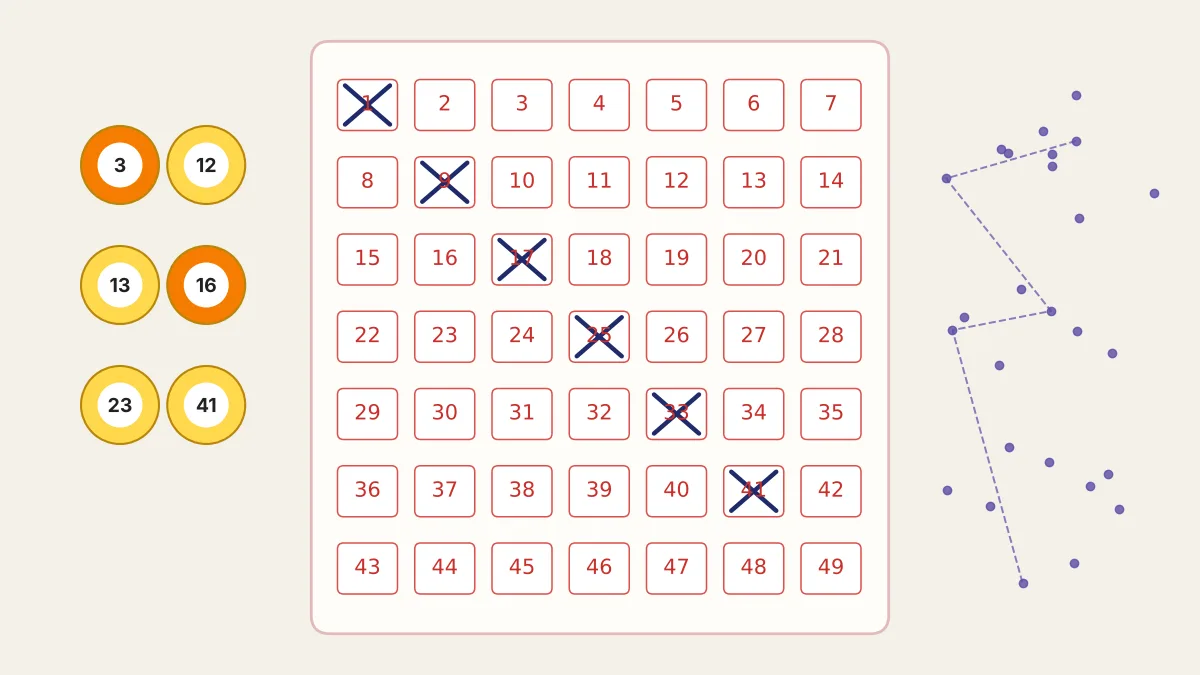
A number came up three times in a row, so it's "hot". Another has been missing for months, so it's "due". Our brains constantly look for patterns, even where there are none. We tested the best-known lottery patterns on every draw of Germany's LOTTO 6aus49 since 1955.
Why we see patterns
Spotting patterns is a strength: if you see a tiger in the bushes too often, you lose little; if you miss it once, you lose everything. With chance, that strength becomes a trap. Psychology knows two classics: the gambler's fallacy ("this number is due") and the hot hand ("this number is on a roll"). They contradict each other, yet both often live in the same head.
Research shows this in real players. In Maryland, bets on a number dropped sharply right after it was drawn and only recovered over several months. In Denmark, online players bet about 2% less on last week's numbers, but more and more on numbers that came up several times in a row. And in the Netherlands, diagonals and vertical lines on the slip were played about 100 times more often than chance would predict (0.9% instead of 0.009% of tickets).
Test 1: Do numbers from the last draw come back?
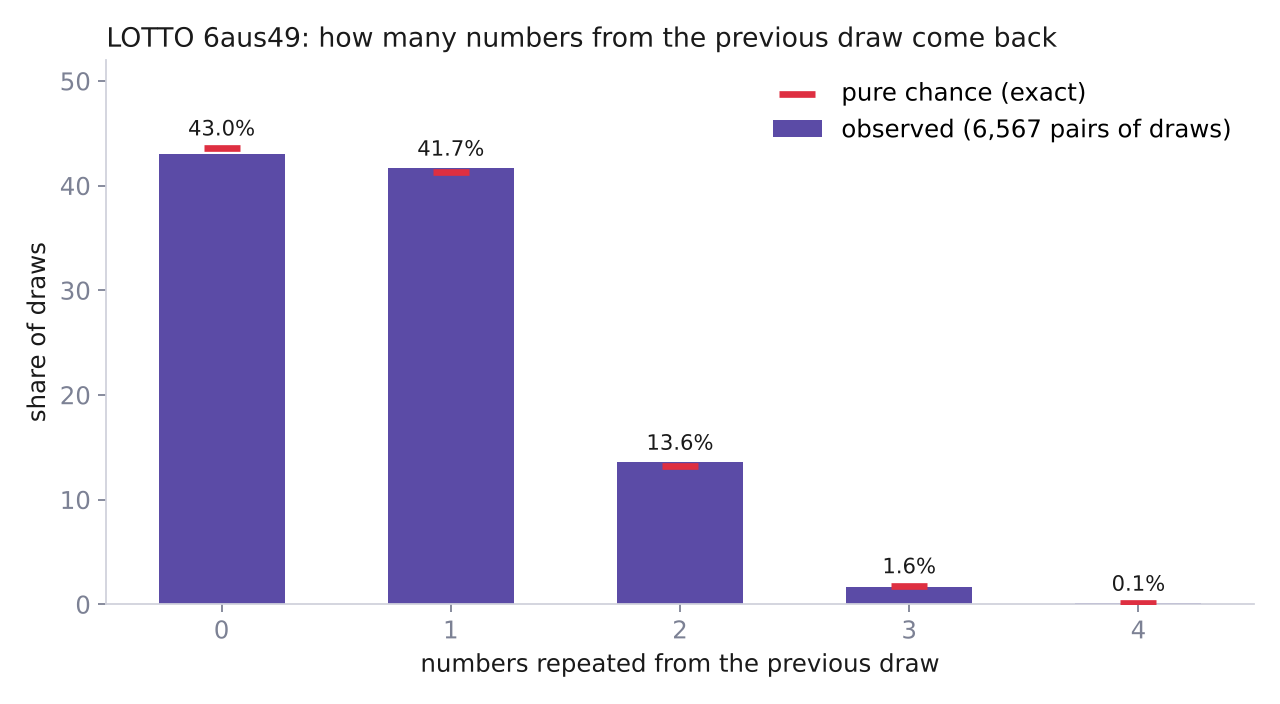
Many players avoid the numbers from the last draw: "they won't come up again straight away". In fact, it happens all the time: in 57.0% of all draws, at least one number from the previous draw came back. The exact value for pure chance is 56.4%.
Test 2: Does a number have a memory?
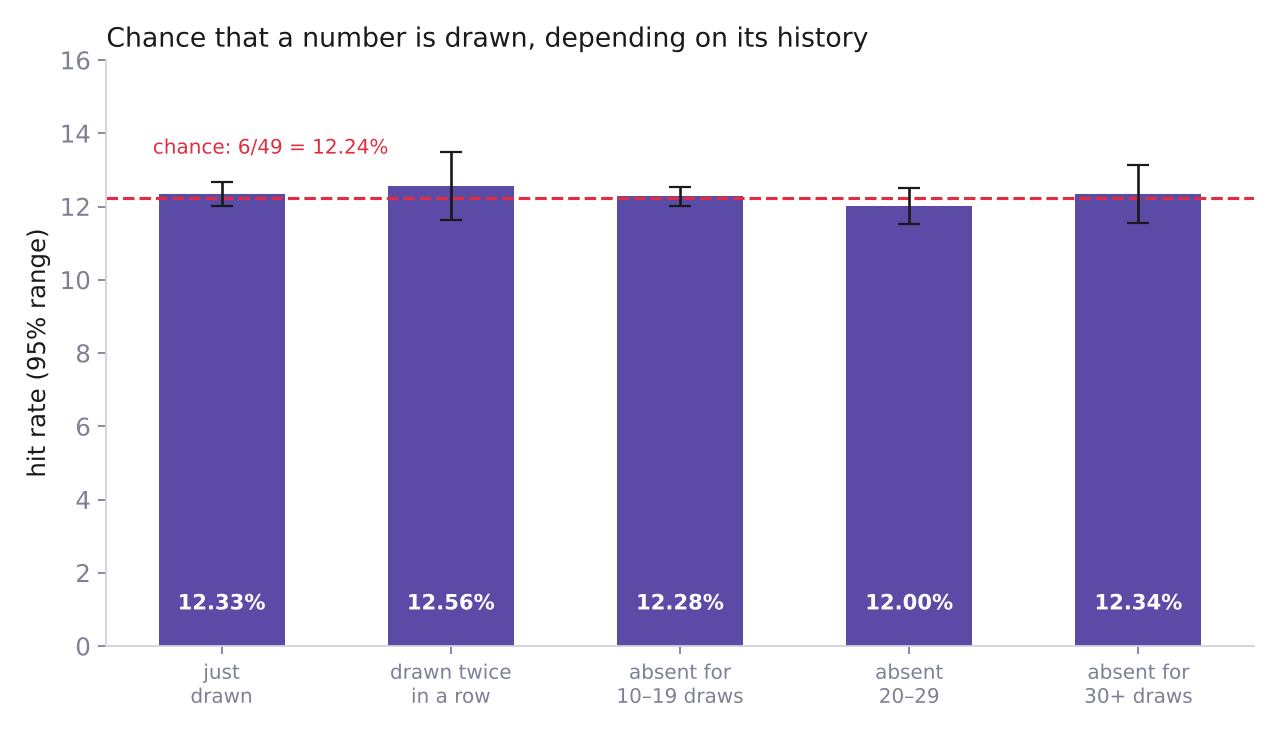
If numbers could be "hot" or "overdue", their chance would depend on their history. For every number and every draw, we looked at what had happened before, around 320,000 cases in total. Result: whether a number was just drawn, came up twice in a row or has been missing for 30 draws, its hit rate stays at 6/49 = 12.24%.
Test 3: Playing hot, cold and overdue numbers
The toughest test is the practical one. For every draw since 1956, we replayed three strategies, always using only the data known beforehand: the 6 numbers drawn most often in the last 50 draws ("hot"), the 6 least drawn ("cold") and the 6 missing the longest ("overdue").
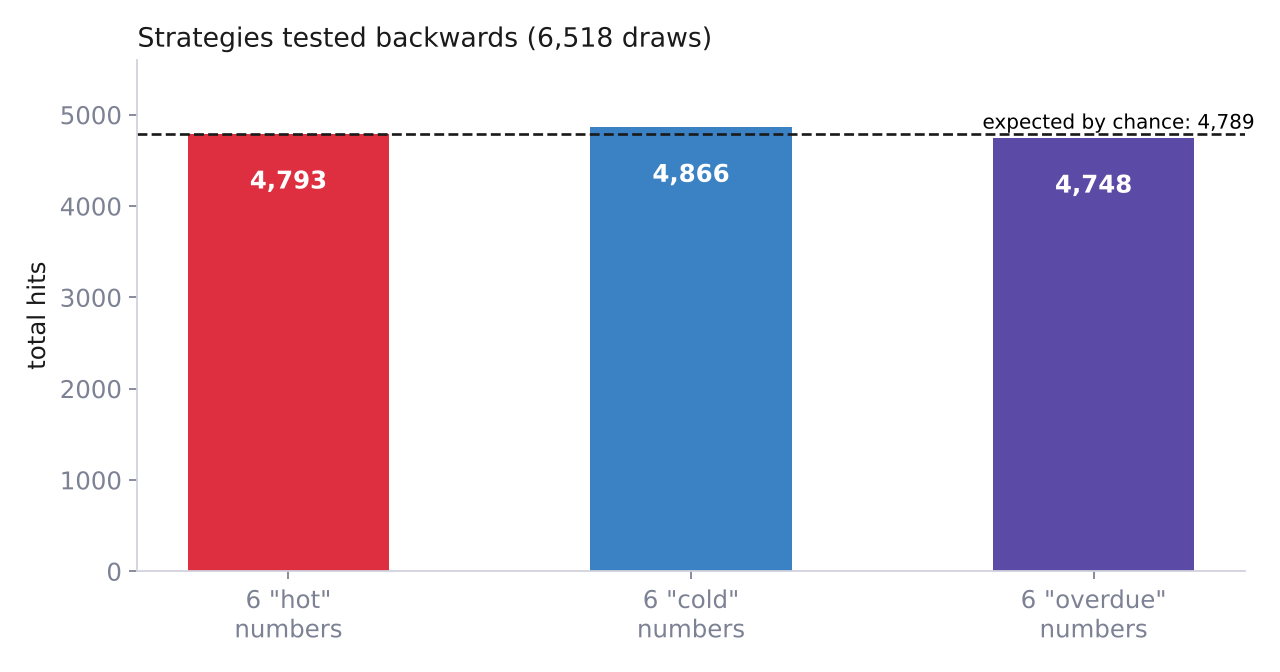
For Eurojackpot (994 draws) and EuroMillions (1,989 draws), the picture is the same: repeated numbers and memory effects sit exactly at chance level, and none of the three strategies beats it. In EuroMillions the "cold" numbers even did slightly worse; with nine tests, one such outlier is expected by chance alone.
What about consecutive numbers?
Two neighbouring numbers like 22 and 23 look "unlikely". In a field study in Warsaw, 70% of people preferred a random-looking ticket to one with a pattern. Yet almost every second LOTTO draw contains at least one pair of consecutive numbers: 50.3% observed, 49.5% calculated. For Eurojackpot it's 34.5% against 35.3%.
No number is hot, cold or due. Every combination has exactly the same chance in every draw. There is one small, real advantage though: if you avoid patterns that many others play (diagonals, lines, birthdays), you'll share a prize less often. It doesn't change your chance of winning, but it does change the amount if you win.
Hot and cold numbersNumber frequencyHow players choose their numbers
Our calculations: LOTTO 6aus49 9 Oct 1955 – 10 Oct 2026 (6,568 draws), Eurojackpot since 23 Mar 2012, EuroMillions since 13 Feb 2004; exact expected values (hypergeometric distribution, combinatorics); walk-forward strategy test with a 50-draw window.