Lottery Defeated review: no proof, no edge, and why you should demand a backtest
On 27 February 2026, an article titled “Lottery Defeated 2026: AI Accuracy Claims Examined” appeared on Yahoo Finance. It looks like news, but it is a paid press release with affiliate links. The product, Lottery Defeated, sells for $197 and promises to pick better numbers for Powerball, Mega Millions and state games. We read what the release actually says: it offers no proof that the product works, and no backtest. Here is why such a test is essential before buying any lottery system.
What the paid release claims
The text carries its own warning: “This is a paid press release.” It also contains affiliate links, so the author earns a commission on each sale. Here is what it reports about the product:
- Price and sale: $197, one-time payment, sold through ClickBank, with a 60-day refund handled by ClickBank.
- Author: “Kenneth Leffer”, which the seller's own terms describe as a pen name.
- Claims: a formula based on “12,400” statistical variables, a filter that removes “losing or repeated combinations”, a database of draws since 1985, a “Smart Pick” generator, and a Fantasy 5 draw where the formula supposedly predicted all five numbers. No state and no date are given.
- Accuracy: none. The release itself says no figure was audited or confirmed by a third party.
- AI: the word appears in the title, but the text describes “historical draw data” and “algorithmic processing”, not artificial intelligence.
Nearly identical “reviews” of the same product have appeared on news sites and press release platforms since at least August 2024. Many look like independent tests but contain affiliate links.
“Filtering losing combinations” changes nothing
A Powerball ticket has a 1 in 292,201,338 chance of hitting the jackpot. That is true for every combination, whether it looks random, follows a pattern or was drawn last week. No filter can remove “losing” combinations before the draw, because none of them is losing until the balls come out.
Removing combinations that were already drawn does not help either. Since October 2015, Powerball has held 1,435 draws. That covers 0.013% of the 11,238,513 possible sets of five white balls. A filter that removes them leaves the game practically unchanged, and the removed combinations were never less likely than the others.
And repeats do happen. In Texas Cash Five (5 from 35), four exact combinations have come out twice since September 2018, for example 5-6-24-30-33 on 18 March 2019 and again on 17 September 2026. In Germany's LOTTO 6aus49, the numbers 15-25-27-30-42-48 were drawn on 20 December 1986 and again on 21 June 1995. A “no repeats” filter would have thrown these winning lines away.
How a Fantasy 5 “prediction” happens without a system
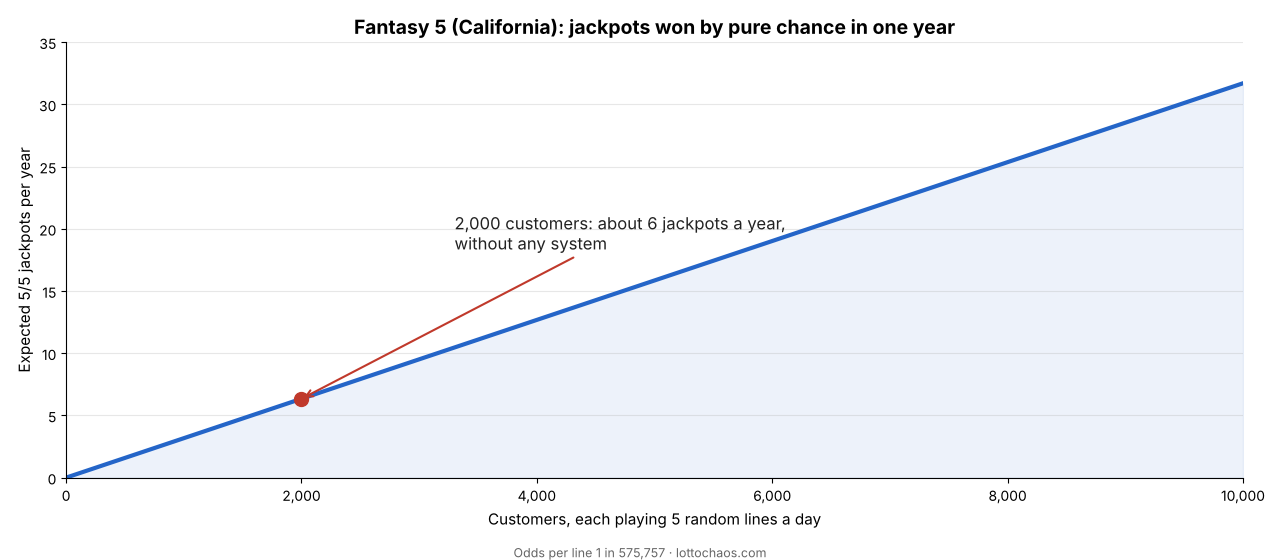
In California Fantasy 5, a $1 line matches all five numbers with odds of 1 in 575,757, and there is a draw every day. That sounds hopeless for one player, but not for a group. If 2,000 customers each play 5 random lines a day, they buy 3.65 million lines a year. On average, about 6 of them will hit the jackpot, without any formula. The seller can then show those wins, while the thousands of losing tickets stay invisible.
Why you should demand a backtest
A backtest checks a method on draws it has not been built on. Without one, success stories prove nothing. A serious test meets four conditions:
- Picks fixed in advance. Either published with a date before each draw, or tested only on draws that were not used to build the formula. A formula tuned on the draws since 1985 will always look good on the draws since 1985.
- All picks counted. The losing lines too, not only screenshots of wins.
- Thousands of draws. One Fantasy 5 hit says nothing: as shown above, a few thousand players produce several per year by chance.
- A comparison with chance. The result must beat the hit rate of random lines, for example one prize in 24.87 Powerball plays, by more than luck can explain.
The number of variables makes such a test even more necessary. The release mentions “12,400” of them, while Powerball has held only 1,435 draws in its current format. With more variables than draws, a formula can describe the past perfectly and still say nothing about the next draw. Statisticians call this overfitting. The release mentions no backtest of any kind. We run such tests on our own strategies: in our bell curve backtest on 1,430 Powerball draws, every strategy returned the same 9.0% on small prizes as random numbers.
What $197 buys in tickets
For the price of the software you could buy 98 Powerball plays. They give a jackpot chance of about 1 in 3 million, and on average 4 small prizes. Or 197 Fantasy 5 plays, with a jackpot chance of about 1 in 2,900. Either way, the software does not change these numbers. It only chooses which combinations you play, and every combination has the same chance.
What actually makes a difference
Only two things matter. The first is your budget: every lottery pays back less than the stake on average. The second is avoiding combinations that many other people play, such as birthdays, rows or the numbers of a recent draw. They do not lose more often, but if they win, the jackpot is shared among more people. Our Powerball anti-patterns tool shows which choices are popular. In our tests, machine learning models also did no better than chance.
Frequently asked questions
Is Lottery Defeated legit?
Nothing shows that it works. Its accuracy claims are not verified, even according to the press release that promotes it, no backtest is published, and no software can change lottery odds.
Why ask for a backtest before buying a lottery system?
Because testimonials only show the winners. Only a test on draws the formula was not built on, with every pick counted and compared with random lines over thousands of draws, can show an edge. Lottery Defeated shows none.
Does Lottery Defeated use AI?
The press release uses “AI” in its title, but its text describes historical draw data and an algorithm. It gives no details about an AI model.
Can software filter out losing lottery numbers?
No. Before the draw, every combination has exactly the same chance. Combinations that were already drawn can come out again: four exact repeats in Texas Cash Five since 2018 show it.
How much does Lottery Defeated cost?
$197 as a one-time payment, according to the February 2026 press release, with a 60-day refund through ClickBank.
Is there any way to improve lottery odds?
Only by buying more lines, which costs proportionally more. You can increase what you keep if you win by avoiding popular combinations, but not your chance of winning.
Before paying for a lottery system, ask for a backtest: every pick, made before the draws, over thousands of draws, compared with random lines. Without it, success stories are just the winners out of many players. Set your budget first; if gambling stops being fun, the US National Problem Gambling Helpline is 1-800-522-4700.
Can you predict the winning numbers?Powerball vs Mega MillionsAll Cash Five draws
Our data: Powerball, 1,435 draws from 07.10.2015 to 18.11.2026; Texas Cash Five, 2,555 draws from 21.09.2018 to 18.11.2026; LOTTO 6aus49, 6,579 draws from 09.10.1955 to 18.11.2026 (Lottochaos files). Our calculations: odds from the number of combinations (5 from 69 × 26, 5 from 39, 5 from 35); expected jackpots = lines played ÷ 575,757.