AI and the lottery: what the studies really show
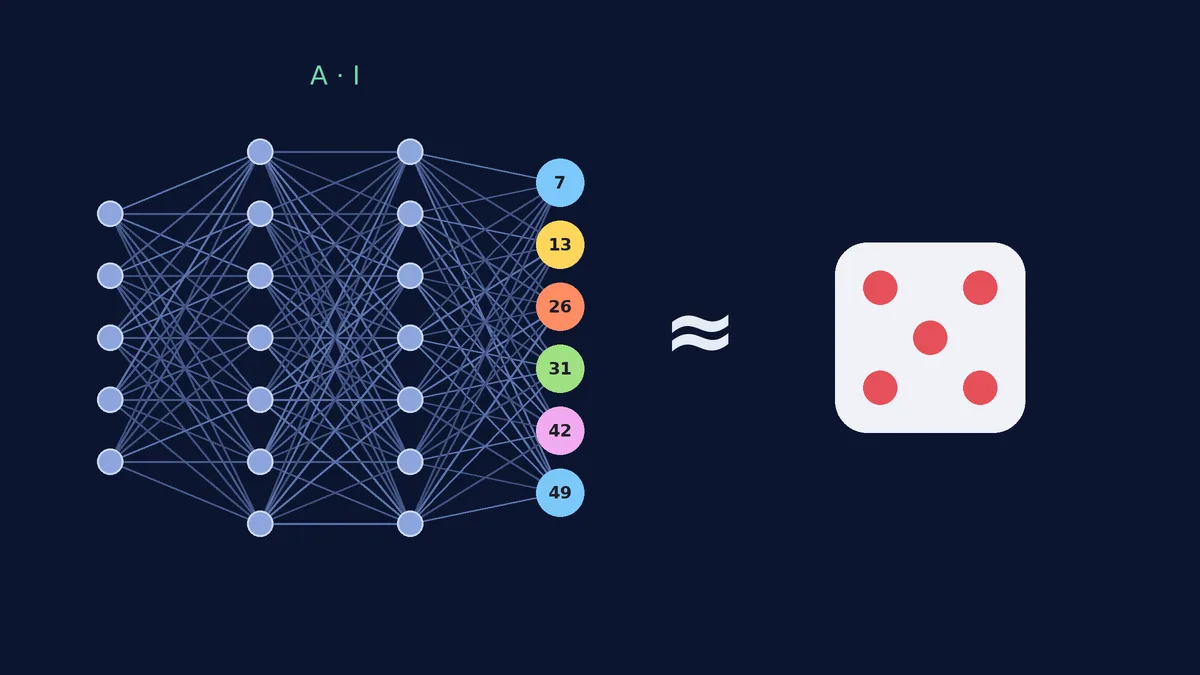
Apps, videos and websites promise that artificial intelligence can find the next winning numbers. We read the published studies, then trained two machine-learning models ourselves on decades of real draws. The result: the AI does exactly as well as a random pick, no better and no worse.
What the "studies" on AI and the lottery contain
SmileyNet (2024). In July 2024, Andreas Birk posted "SmileyNet – Towards the Prediction of the Lottery by Reading Tea Leaves with AI" on arXiv. The title says it all: a neural network is first trained on smileys to put it "in a good mood", then reads tea leaves to predict coin flips. It reports 72% accuracy, against 49% for ResNet-34 and 53% for YOLOv5, and concludes that several SmileyNets combined could win the lottery. Not a single lottery draw is tested.
Deep learning and time series (2023). An article by Samy S. Abu-Naser in the International Journal of Engineering and Information Systems (IJEAIS) applies deep learning and time-series analysis to a lottery dataset from Kaggle. Its abstract mentions the "promise and limitations" of AI, but gives no accuracy figure and no comparison with randomly chosen numbers.
A probability model (2024). On arXiv, Thando Nkomozake proposes a statistical model (Compound-Dirichlet-Multinomial) to "predict winning numbers" for 6-number, 5-number, pick-4 and pick-3 games, with a strategy said to be profitable for pick-3. The abstract describes no validation on draws that were not used to build the model, and no hit rate.
What these papers have in common: none shows the one thing that matters, a model that finds more correct numbers than a random line on draws it has never seen.
What data really reveals: players' choices
The serious lottery studies are about players, not balls. In 2016, four Dutch researchers (Wang, Potter van Loon, van den Assem and van Dolder) analysed 5.1 million combinations played online in the Dutch Lotto by 131,407 players. People favour small numbers (11 is the most popular), birthdays, numbers in the middle of the slip, sequences and patterns. Because prizes are shared between winners, a popular combination pays each winner less. That is the only thing data analysis really changes: not your chance of winning, but how much you share.
Our test: two AI models against chance
Rather than rely on other people's papers, we ran the test ourselves with our open data. Before each draw, the model only sees the past: how often each number came up in the last 10, 50 and 200 draws, how many draws since it last appeared, and whether it was drawn last time. Two standard machine-learning models (logistic regression and gradient boosting, i.e. combined decision trees) learn on the first 70% of draws and are then tested on the remaining 30%, which they have never seen. In each draw, the model plays the numbers it rates most likely. We count the correct numbers, on average per draw:
| Game | Draws tested | Chance | Logistic regression | Gradient boosting |
|---|---|---|---|---|
| LOTTO 6aus49 | 1,911 | 0.735 | 0.719 | 0.725 |
| EuroMillions | 537 | 0.500 | 0.454 | 0.493 |
| Eurojackpot | 239 | 0.500 | 0.485 | 0.490 |
The "Chance" column is what a random line gets on average (6 × 6 / 49 in Lotto 6aus49, 5 × 5 / 50 in the other two). Both models stay within the margin of error, if anything slightly below. The same goes for "hot" and "overdue" numbers: across 8 lotteries, neither method beats chance (our data on GitHub and Kaggle lets you redo the calculation).
Why AI cannot do better
There is nothing to learn. AI finds regularities in data. But balls have no memory: each draw is independent of the previous ones, and machines and balls are tested to keep it that way. Past draws therefore contain no information about the next one. No neural network, however large, can extract information that does not exist.
It memorises the past. With a few thousand draws and millions of parameters, a network can "recall" the training draws perfectly. An accuracy measured on those draws proves nothing. Only a test on unseen draws, in time order, counts.
Always compare with chance. "The AI got 3 numbers right" sounds impressive, but in Lotto 6aus49 a random line gets 3 or more right about once in 54 draws, and in EuroMillions about once in 209. Without that comparison, a result means nothing.
The bottom line
No published study shows that AI can predict lottery numbers, and our own test confirms it performs exactly like chance. AI is useful for checking that draws are truly random, or for understanding which numbers players prefer. For picking numbers it is no better than a random generator, but it can help you avoid the combinations everyone else plays.
Frequently asked questions
Can AI predict lottery numbers?
No. Draws are independent: past results say nothing about the next draw. In our test on unseen draws, two AI models found on average as many correct numbers as a random line.
What about ChatGPT or "lottery AI" apps?
They produce numbers, but none publishes a test on future draws compared with chance. Without that test, there is no evidence they do better than a random generator.
Are there scientific studies on this?
A few papers propose prediction models, but their abstracts show no validation against chance. The solid studies are about player behaviour, such as people's favourite numbers.
So what is AI good for here?
Testing whether draws are random and spotting popular combinations. Avoiding those does not change your chance of winning, but it lowers the risk of having to share a big prize.
If an app promises you "AI numbers", ask for its test on future draws compared with chance. You can also try it yourself in our Eurojackpot AI test or Lotto 6aus49 AI test: you train a neural network on real draws and see how it scores against chance.
Can you predict lottery numbers?Patterns in chanceOur open data
Our test: Lottochaos open data (Lotto 6aus49 since 1955, EuroMillions since 2004, Eurojackpot since 2012, as of October 2026); features computed only from earlier draws; training on the first 70% of draws (after the first 200), test on the following 30%; logistic regression and gradient boosting (scikit-learn, 150 trees of depth 3); in each draw, the K numbers with the highest probability. Standard error of the mean: 0.017 (Lotto), 0.027 (EuroMillions), 0.039 (Eurojackpot). We read the abstracts of the cited papers and report their claims as stated.