AI lottery prediction: we tested 8 models on 500 draws they had never seen
A screenshot with 4 matching numbers, a video saying "my AI called the draw", software that promises machine learning: you see one every week. What you never see are the hundreds of draws where it did not work. So we did the opposite. Instead of showing one lucky hit, we measured. Eight methods, 500 draws each, two lotteries.
Why the "proof" you see online proves nothing
Picture 1,000 people each playing one "AI calculated" line. In German Lotto 6aus49, about 18 of them will get 3 or more numbers right by pure luck. Those 18 post their screenshot. The other 982 stay quiet. That is survivorship bias: you only ever see the winners, never the denominator.
So the only question that matters is: over many draws, does the method match more numbers than a random line?
The 8 methods we tested
We picked the approaches that show up most often in apps, paid software and projects on GitHub.
| Method | The idea in one sentence |
|---|---|
| Neural network | Learns from the last 10 draws which numbers come next (the same principle as projects such as LottoProphet, which use an LSTM). |
| SARIMA | Treats every number as a time series, with a "seasonal" effect of two draws a week. |
| Markov chain | Estimates a number's chance from how many draws have passed since it last appeared. |
| Logistic regression | Combines recent frequencies, gaps and last week's result: the classic "statistical predictor". |
| k nearest neighbours | Searches the past for situations most like today's and looks at what came next. |
| Holt-Winters | Smooths each number's frequency and follows its trend, like a sales forecast. |
| Bayesian model | Starts from pure chance and updates each number's probability after every draw, with older draws counting less. |
| Genetic algorithm | Evolves a population of lines that "would have done well" on recent draws. |
The rule: no peeking
This is where most demos cheat, often without noticing. If a model has seen the draw it is supposed to predict, even indirectly, it will look brilliant. In our test, for each draw the model only learned from the draws before it. Then it played one line. Then we moved on to the next draw, 500 times.
Periods: Eurojackpot from 19 November 2021 to 17 November 2026, German Lotto 6aus49 from 5 February 2022 to 18 November 2026. We count matching main numbers only (no Euro numbers, no Superzahl).
The result
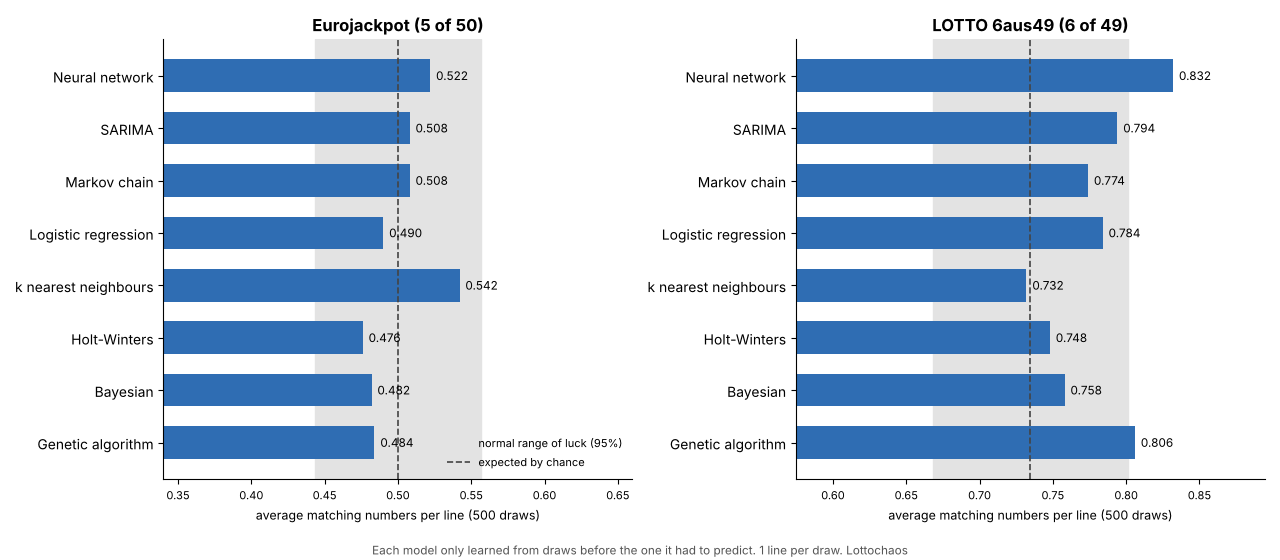
| Method | Eurojackpot (chance: 0.500) | Lotto 6aus49 (chance: 0.735) |
|---|---|---|
| Neural network | 0.522 | 0.832 |
| SARIMA | 0.508 | 0.794 |
| Markov chain | 0.508 | 0.774 |
| Logistic regression | 0.490 | 0.784 |
| k nearest neighbours | 0.542 | 0.732 |
| Holt-Winters | 0.476 | 0.748 |
| Bayesian model | 0.482 | 0.758 |
| Genetic algorithm | 0.484 | 0.806 |
In Eurojackpot, every method stays inside the range of luck: some a little above, some a little below, exactly like randomly chosen lines.
The second, tougher test
Counting matches is not enough, because a line can hit by luck. Each model also gives every number a probability, so we can grade it: did it give more chance to the numbers that were actually drawn? Statisticians call this grade log loss; lower is better.
A model that simply says "every number is equally likely" scores 16.25 in Eurojackpot and 18.22 in Lotto 6aus49. None of the 8 models did better. The best ones tied (Markov, logistic regression). The rest did worse because they were confidently wrong: 20.80 for the neural network in Lotto, 34.82 for the genetic algorithm.
What about the two bars that stick out?
In Lotto 6aus49, the neural network (0.832) and the genetic algorithm (0.806) land just outside the grey band. Is there something there? We ran 16 tests (8 methods, 2 lotteries). With a 95% band, about one result in twenty falls outside by pure luck. One or two "remarkable" results out of 16 is normal.
We checked anyway and reran both models on 1,000 draws instead of 500 (since April 2017). The neural network drops to 0.729 matching numbers per line and the genetic algorithm to 0.767, against 0.735 expected. Over 1,000 lines the neural network got 3 or more right 19 times; chance predicts 18.6. The edge is gone. It was a good streak, not a discovery.
Why this makes sense
An AI finds regularities in data. But lottery balls have no memory: the draw machine does not know which number came up last week. There is no pattern to find, and a model that finds one anyway is learning noise. That is why the "smartest" models often do worse than the simplest: they cling to coincidences. More on this in patterns in chance and in what the studies say about AI and the lottery.
What really matters when you play
No method changes your odds of winning. Two things do change what you win or lose. First, your budget: every lottery pays back less than it takes in, on average. Second, popular combinations: birthdays, sequences, last week's numbers. They do not come up less often, but if they hit a big prize you share it with far more people.
Frequently asked questions
Can AI predict lottery numbers?
No. On 500 draws they had never seen, our 8 models matched as many numbers as a random line, and none estimated the probabilities better than a plain "every number is equal".
Why do some programs show wins?
Because only the successful draws are shown, or because the model was tested on draws it already knew. On truly new draws, the edge disappears.
Which method is best?
None. The small differences between methods change from one period to the next and stay within the margin of luck.
Is it worth paying for AI lottery predictions?
No. A "calculated" line has exactly the same chance as a quick pick. The only measurable effect is spending more.
Play the numbers you like, an AI will not do better. Avoid birthdays and sequences so you do not have to share a jackpot, and set your budget before you play. Want to watch AI lose to chance live? Try our Eurojackpot AI lab or the German Lotto AI lab.
Test the AI yourselfAI and the lottery: what the studies showCan you predict lottery numbers?