Can you audit a lottery?
Researchers from Mexico and Italy designed a kind of "MOT test" for lottery draws. Their test failed two periods of draws. We put our own data through the same test.
The problem: you can't "prove" randomness
A sequence of numbers doesn't come with a "truly random" label. The authors say so themselves: you can never prove that a sequence is random. You can only check whether it is consistent with a fair draw. That is exactly what an auditor does: they don't certify innocence, they look for suspicious deviations.
The clever idea: look at the sorted ticket
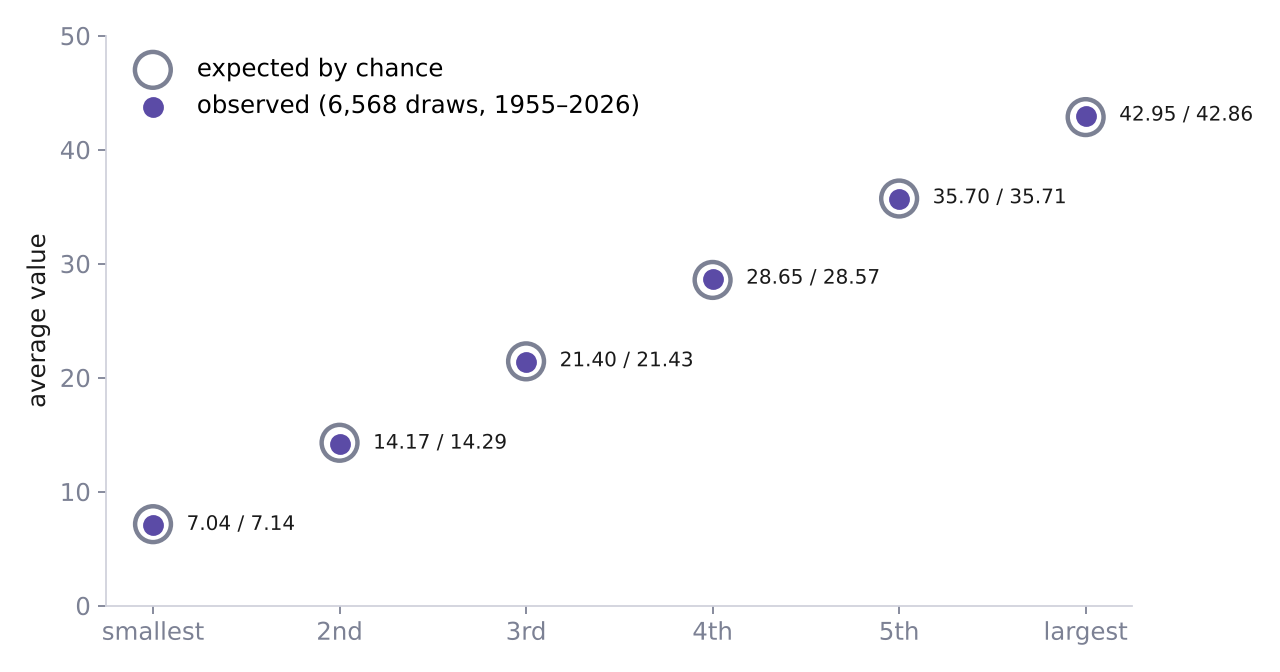
Take a draw of Germany's LOTTO 6aus49 (6 numbers from 49) and sort the numbers from smallest to largest. Over thousands of fair draws, the smallest number averages 7.14, the second 14.29 … and the largest 42.86. Mathematics gives these values exactly: 1×50/7, 2×50/7 and so on.
The authors compare these six observed averages with the expected ones, taking into account how they vary together. From this they get a single number, Q. If the balls are fair, Q follows a known distribution (the χ², "chi-squared"). A Q that is too large signals an unlikely deviation.
The paper's verdict: two periods fail
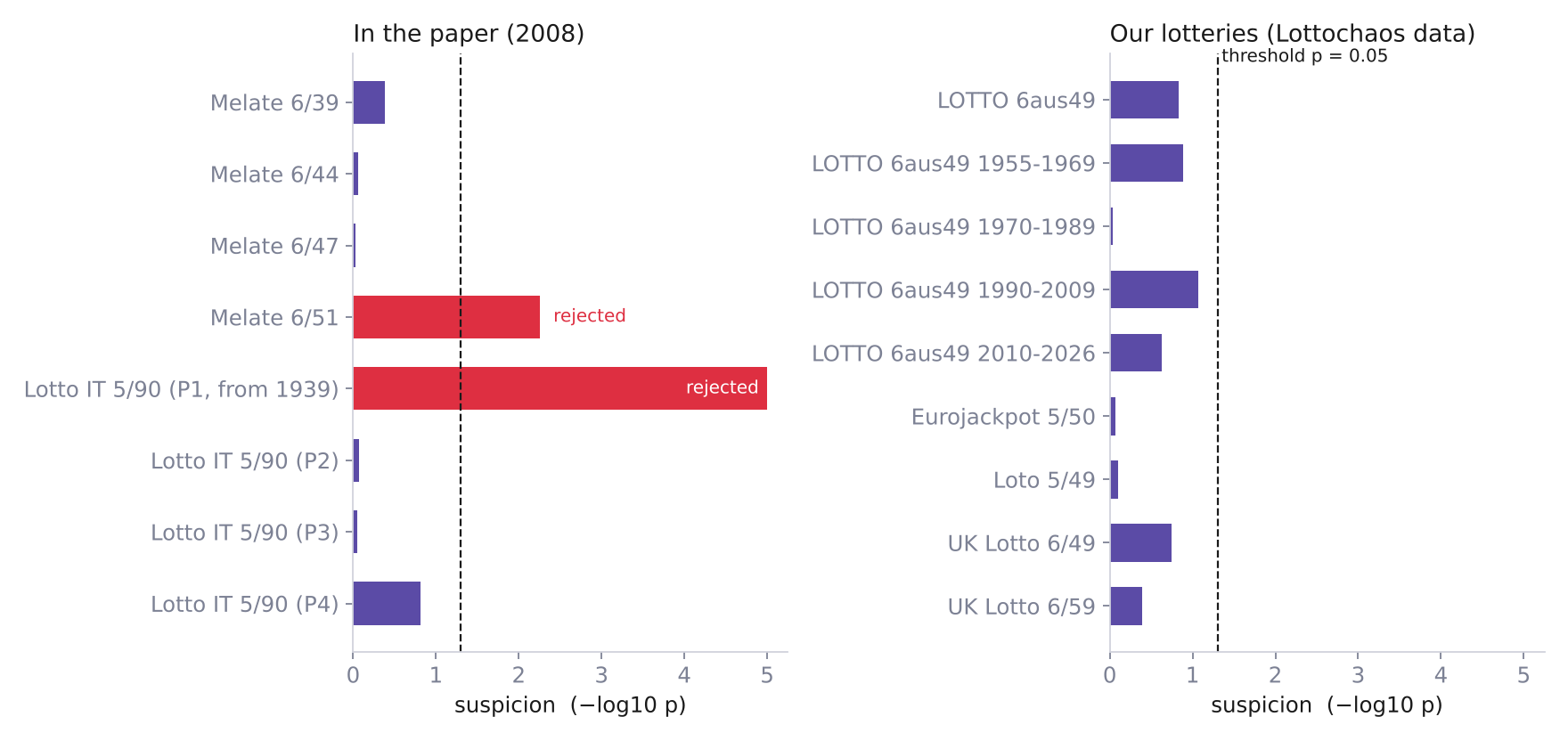
The researchers tested Mexico's Melate (6 numbers, from 39, 44, 47 and then 51 balls depending on the year) and the Italian Lotto (5 from 90, Rome wheel, since 1939). Six periods pass without trouble. Two fail: Melate 6/51 (2005–2007, p = 0.0056) and the first Italian period, starting in 1939 (p < 0.00001). For the latter, the authors write that the data do not fit a fair draw of the 90 balls.
Our audit: everyone passes
We applied the same test to our archives (data up to mid-October 2026). Result: none of our lotteries fails. LOTTO 6aus49 over 71 years (p = 0.15), each of its four main periods, Eurojackpot (p = 0.86), the French Loto (p = 0.79), and UK Lotto both before and after its switch from 49 to 59 balls in 2015.
With a 5% threshold, a perfectly fair series of draws "fails" one time in twenty, purely by chance. The paper tests 8 periods, so a single rejection at p = 0.0056 should be taken with caution. The more tests you run, the more innocent "culprits" you find. The Italian rejection at p < 0.00001, on the other hand, is far more solid.
Question for you: across our 9 tests, how many false rejections would you expect by chance? (Answer: about 0.45. We found 0.)
The takeaway
A fair lottery has no memory. A test like this can detect a faulty draw machine, but it will never tell you which numbers come up on Saturday.
Test fairness in the LabNumber frequenciesChance explained
Our calculations: the paper's Q statistic (exact means and covariances of the sorted numbers, χ² distribution with k degrees of freedom), applied to the Lottochaos archives.