538 winners instead of 90: when everyone plays the same numbers
The balls are drawn at random. The players don't choose at random. Two British statisticians showed what that means for prizes.
The spanner in the works: "conscious selection"
If every player picked their numbers at random, the number of winners in a prize tier would be very predictable. It would follow a Poisson distribution and vary little from draw to draw. But we pick dates, lucky numbers, patterns on the play slip. Statisticians call this conscious selection.
R. D. Baker and I. G. McHale (University of Salford) studied the UK National Lottery. They show that conscious selection creates huge overdispersion: some draws have far more winners than expected, others far fewer. It also creates strong correlations between prize tiers. The "theoretical" models work so badly that the authors had to build a model from the real data.
We checked it with LOTTO 6aus49
We took the 1,087 draws of Germany's LOTTO 6aus49 since May 2013. For each one, we calculated how many "5 numbers + Superzahl" winners pure chance should have produced, given that draw's ticket sales. Then we compared with the actual winners.
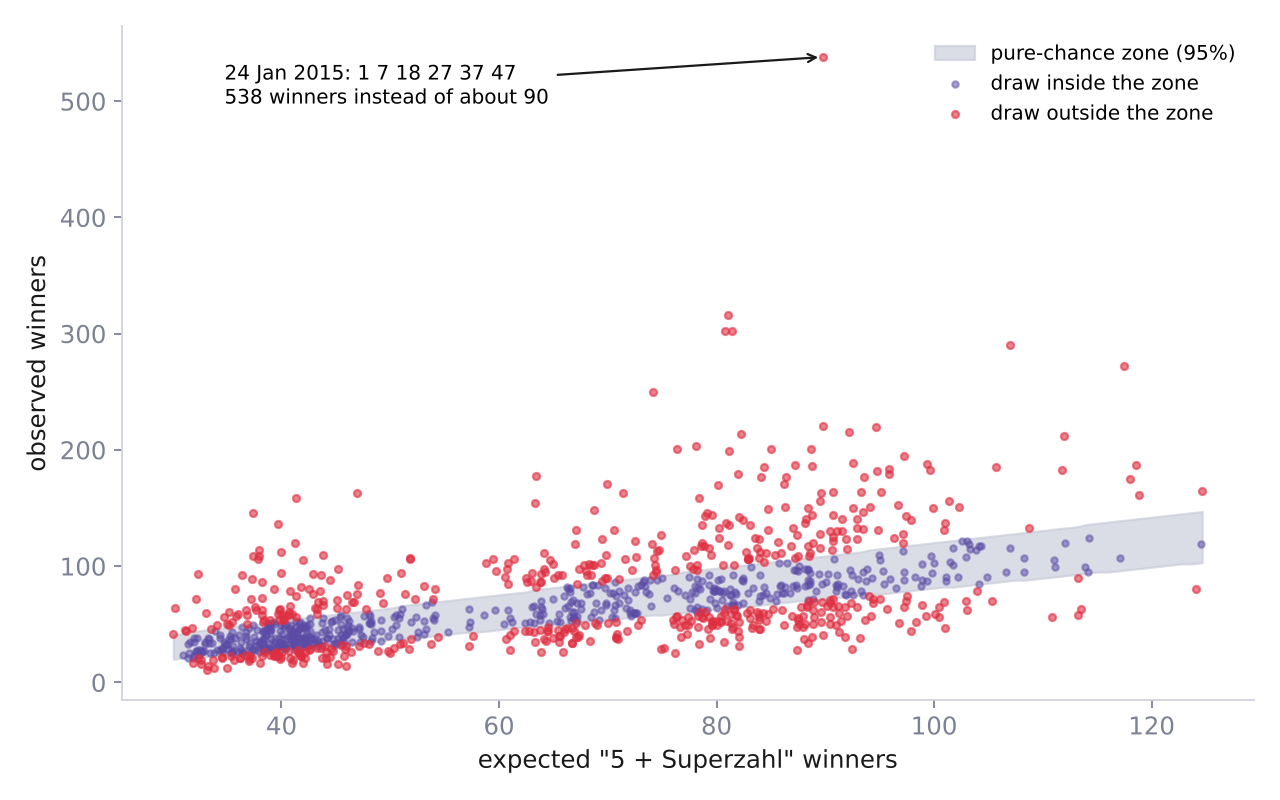
The result is spectacular. The spread is about 18 times larger than pure chance. The record: 24 January 2015, with 1 7 18 27 37 47, had 538 winners instead of about 90. At the other extreme, 2 August 2017 (21 22 23 34 36 49) had only 14 instead of about 46.
The birthday signature
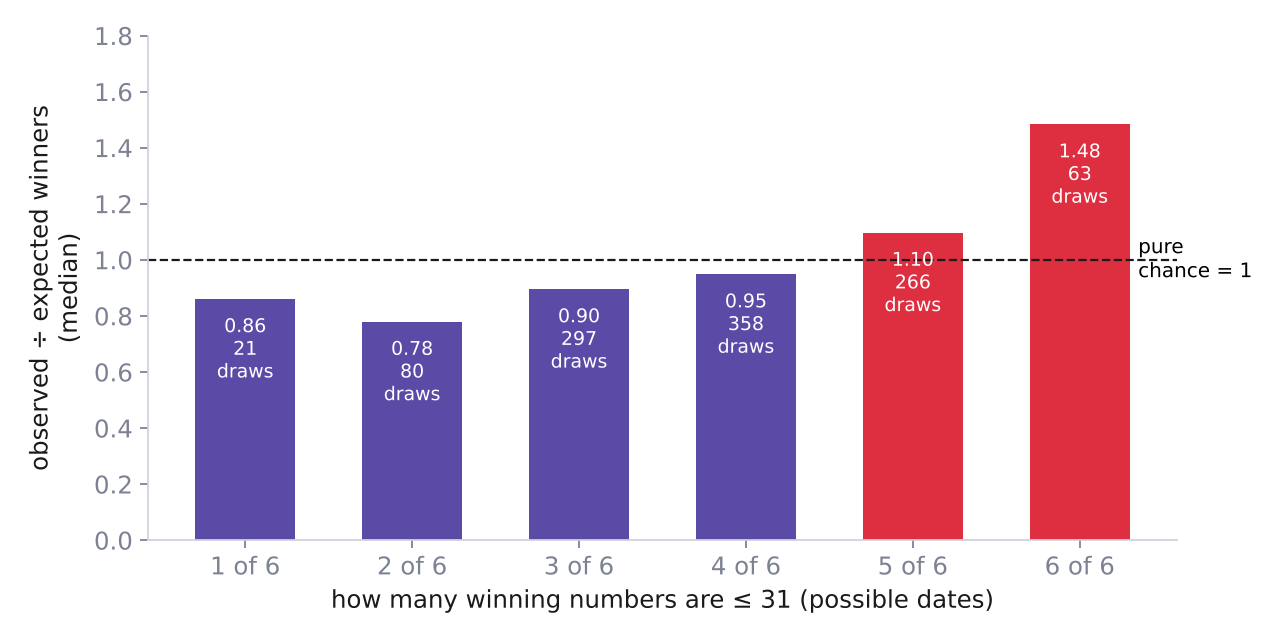
When all six winning numbers could be days of the month, there are 48% more winners than expected (median). With few "dates", there are fewer. That's conscious selection in action.
Your chance of hitting the right numbers is always the same, whatever your ticket. But if you win, how many people will you share with? That depends on your ticket. Baker and McHale suggest a player could improve the average value of their ticket by choosing less popular numbers. It still doesn't make the game profitable.
Is my ticket popular?Anti-patternsPrizes by tier
Method: number of tickets estimated from ticket sales (€1.00 per line until 22 Sep 2020, €1.20 afterwards). This is an approximation: it doesn't change the order of magnitude of the gaps.
Our calculations: official prize tiers and payouts of LOTTO 6aus49, 4 May 2013 to 10 Oct 2026.