10 lines covering all 50 numbers: more frequent wins, but no more money
A simple method goes around among players: shuffle the numbers 1 to 50 and spread them over 10 lines, so that every number is played exactly once. The 5 winning numbers are then bound to be somewhere in the lines. We worked out what the method changes, then tested it on 1,523 real Eurojackpot and EuroMillions draws.
The principle
Eurojackpot and EuroMillions both draw 5 numbers from 50, plus 2 bonus numbers from 12 (the Euro numbers or the Lucky Stars). With coverage, you shuffle the 50 numbers and cut them into 10 lines of 5: no number is left out, none is played twice. For the bonus numbers, 10 lines offer 20 slots for 12 numbers: each one is used at least once, 8 of them twice.
The direct consequence: in every draw, your 10 lines together hold exactly 5 correct numbers, no more and no less. The only question is how they are spread.
What the method changes: correct numbers end up together more often
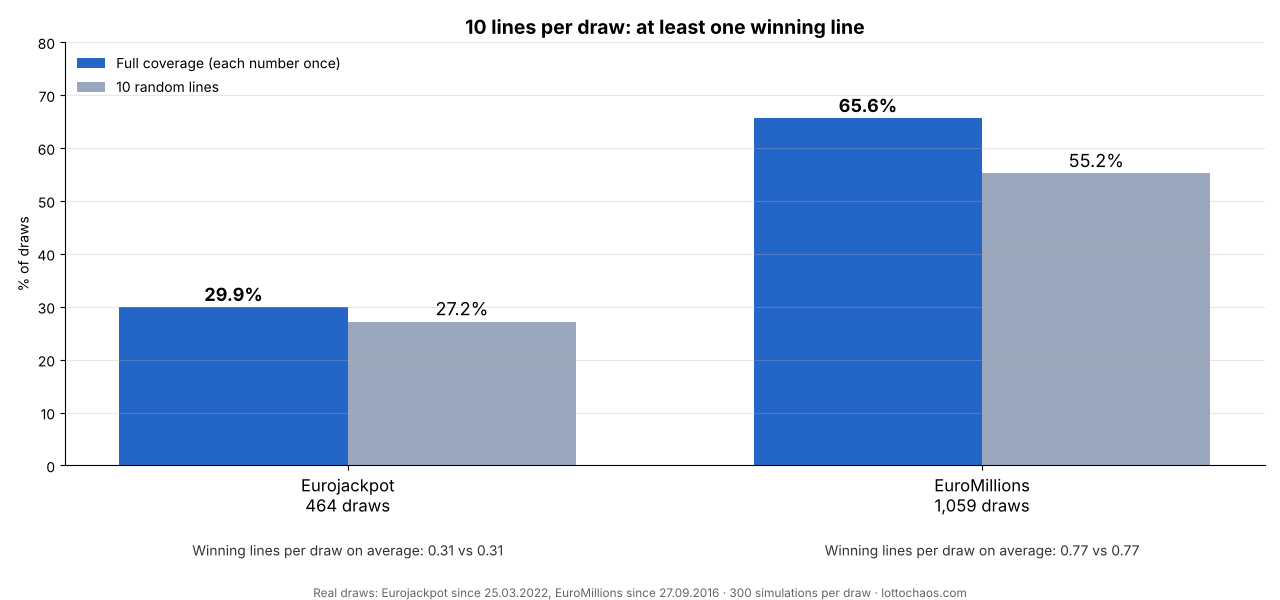
If the 5 winning numbers fall into 5 different lines, each line has only one correct number and the main numbers win nothing. The exact calculation shows this happens in 37.2% of draws. In the other 62.8%, at least one line has 2 or more correct numbers. With 10 random lines, independent of each other, that only happens in 52.4% of draws.
On real draws, the effect is clear:
| Game | Draws | At least one winning line: coverage | 10 random lines | Winning lines per draw: coverage | 10 random lines |
|---|---|---|---|---|---|
| Eurojackpot (since 25.03.2022) | 464 | 29.9% | 27.2% | 0.31 | 0.31 |
| EuroMillions (since 27.09.2016) | 1,059 | 65.6% | 55.2% | 0.77 | 0.77 |
The gap is much bigger in EuroMillions. The reason is the prize table: EuroMillions already pays for 2 correct numbers without a Lucky Star, while Eurojackpot also needs at least one Euro number (2 + 1). A line with 2 correct numbers therefore always wins in EuroMillions, but not always in Eurojackpot.
What it does not change
The last column of the table matters most: the average number of winning lines per draw is exactly the same, 0.31 in Eurojackpot and 0.77 in EuroMillions. These are the values theory predicts: about one line in 32 wins in Eurojackpot, one in 13 in EuroMillions. The reason is simple: taken on its own, each line of the coverage is just a random line. The long-run average return is therefore identical.
- The jackpot: 10 chances in 139,838,160, exactly like any 10 different lines.
- The top tiers: at least one line with 3 or more correct numbers in 4.8% of draws, against 4.7% with random lines. Practically no difference.
- The cost: 10 lines cost €20 per Eurojackpot draw and €25 per EuroMillions draw in France.
Coverage does not create winnings, it spreads them differently. Small prizes come more regularly, and draws where several lines win at once become slightly rarer. It is the same principle as system bets, the other way round: a system bunches the prizes together, coverage spreads them out.
How to use it
Our number generator now offers the mode “Full coverage (each number once)” for Eurojackpot and EuroMillions. It produces the 10 lines in one go, with every bonus number used. If you play 10 lines per draw anyway, the method makes wins more regular at no extra cost. If you play fewer, it does not apply: a single line of the coverage is just a random line.
Frequently asked questions
Does covering all 50 numbers improve the odds?
The odds of at least one prize per draw: yes, 65.6% instead of 55.2% in EuroMillions with 10 lines, 29.9% instead of 27.2% in Eurojackpot. The average return and the jackpot odds: no, they stay the same.
Why does the average return not change?
Because each line, on its own, is a random line. The method only changes how the correct numbers are spread across the lines, not their total, which is always 5.
How many lines do you need to cover all 50 numbers?
10 lines of 5 numbers. For the 12 bonus numbers, the 20 slots of the 10 lines are enough to use each one at least once.
Does it work for Powerball or Mega Millions?
Powerball draws 5 from 69: 13 lines cover 65 numbers and 4 are left over. The principle is the same, but coverage is not complete, and the expected return still does not change. Our generator offers the mode for Eurojackpot and EuroMillions only.
Coverage makes small prizes more frequent without increasing what you get back on average: 10 lines are still 10 lines. Set your budget before playing, and do not play 10 lines just to use the method.
System bets: how much more chance?Can you predict the winning numbers?EuroMillions expected value